


Collaboration, when described by Dr. Shelle VanEtten, can be visualized as an “arms wide open” stance. A stance that allows individuals to “harness the power of collaboration to move big things” together (VanEtten, 2014). Emily Eldridge states an individual’s approach to collaboration is a sum of their life experiences, personality, and contextual knowledge (Eldridge, 2012). Similarly to Eldridge I struggled with this as a child; unlike Eldridge it wasn’t my personality, but my early childhood experiences. Over time and with a lot of patience, I overcame my fears and now feel comfortable collaborating with others. I am comfortable taking a back seat to let others lead, and when necessary, I am happy to jump in the captain’s seat and steer the ship forward. Both Dr. VanEtten and Eldridge offer attainable solutions for those of us looking to improve our collaborative skills. From the art’s perspective, Jesse Eisenberg and Amy Franceshini individually discuss their approaches to collaboration within the arts and how to stay true to our emotions while doing it.
The “I” in Teamwork
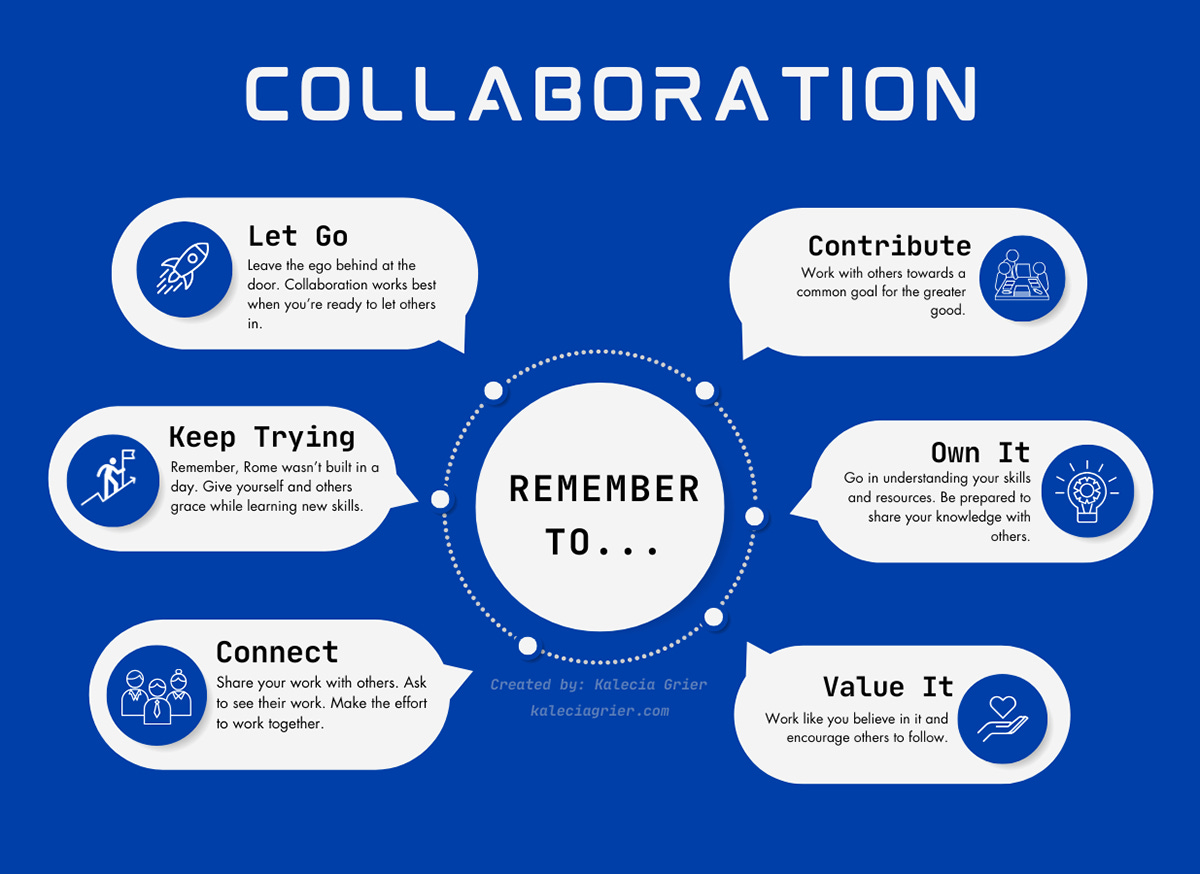
It is easier to be a part of a team when your inner world is secure. From my view, understanding your strengths and weaknesses, believing in your value and inherent worth, and upholding your boundaries allow you to be a better team player. The expression goes “there is no “I” in team,” but I disagree. The individual must be ready and willing to participate in the group, or they will likely willingly or even unknowingly negatively impact the collaborative effort. To be a part of a team means to compromise, when necessary, be willing to listen to understand others and to work towards a common goal with equal effort. Eldridge advises us to show up understanding what we offer and be able to articulate it to others; to be honest and authentic about our habits (e.g., a private, pragmatic thinker vs a quick, bounce-back-and-forth thinker); to always value the process and continue to encourage others to participate with equal efforts; and finally, to understand the common goal and truly work hard together to achieve it (Eldridge, 2012). Dr. VanEtten also offers us five pieces of advice that resonated with me. She begins with the ego. We must let go of our ego in order to collaborate with others effectively. “Practice makes perfect”, we should give ourselves grace as we learn to collaborate with others. I can attest to this; be patient with yourself, Eisenberg will also be mentioned to discuss this later. To be collaborative means we have to share our work with others as they should share theirs with us; it’s the whole point. Again, the ego must let go of its tight grasp on our ideas because to hold tightly is to keep things “very safe and very small.” Lastly, teamwork does not immediately equal collaboration. It is up to each individual to actively participate in the group effort in order for it to be a collaborative act.
The Humanity of the Arts
Big projects naturally require collaboration to complete in a timely manner. If we zoom out, we should easily remember humanity is really just one big group project. Ideally, we collectively discuss the needs of the other and find ways to achieve these things for the greater common good. Zooming in and looking at public art projects and the film industry collaboration is essential to success. Artist, Amy Franceshini, talks about the collaborative efforts required for public arts projects to come to life. Within her collective, FutureFarmers, they have built a central mission fueling their efforts. They are a collective that is committed to completing projects that move them beyond their current skillsets and knowledge bases to then pass it on to local communities through interactive workshops and exhibitions (Franceschini, 2015). Actor, writer, and director, Jesse Eisenberg implores viewers and himself to try to remember that you are not alone in your feelings. Although anxiety is not always coming from a rational place, we don’t have to ignore it or dismiss the feeling (Eisenberg, 2024). Instead, we should aim to use it because it is there telling us something. Feelings do not have a laden value; they are also the very thing that makes us human. Understanding and honoring your anxieties and remaining accountable within a collective are a few ways we can effectively collaborate within the arts.
Works Cited
1. VanEtten, S. (2014). The power of collaboration: Dr. Shelle VanEtten de Sánchez at TEDxABQWomen. YouTube.
2. Eldridge, E. (2012). Why Collaboration Is An Individual Effort: Emily Eldridge at TEDxMU. YouTube.
3. Eisenberg, J. (2024). Master your anxiety. Unleash your genius | Jesse Eisenberg for Big Think+. YouTube.
4. Franceschini, A. (2015). Collaborative Art with Amy Franceschini | KQED Arts. YouTube.
